Char Dham Yatra 2026: Registration, Route, Cost & Dates
Char Dham Yatra 2026: Registration, Route, Cost & Complete Guide
Updated: September 2026
| Reading time: 9 min | By
Meri DevBhoomi Team
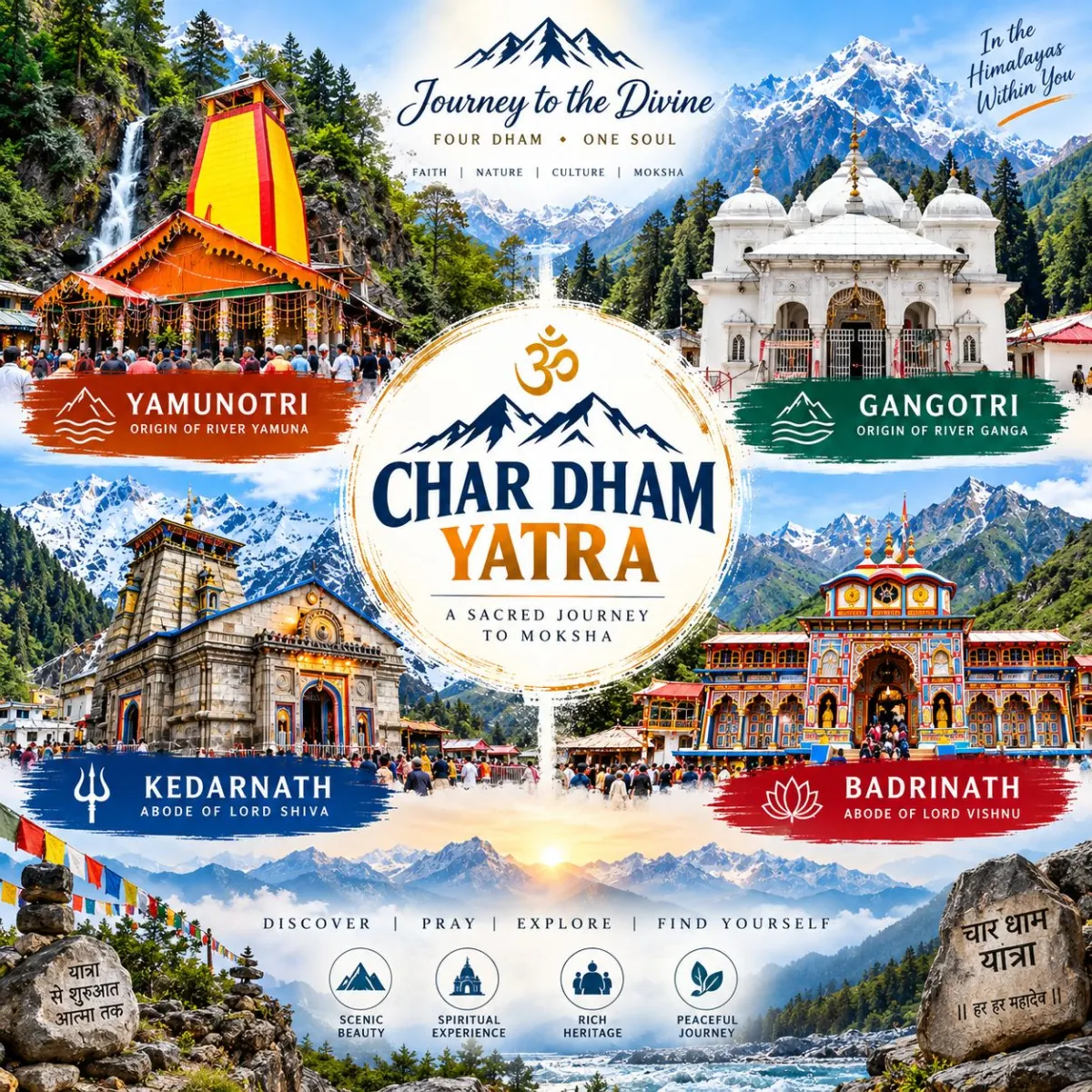
The Char
Dham Yatra 2026 is still on, and September–October is one of the best
windows to do it. The monsoon rush thins out, skies clear up, and the mountains
look their best. If you are planning to visit Yamunotri, Gangotri, Kedarnath
and Badrinath before the temples close for winter, this guide covers
everything in one place: free registration steps, the exact route,
a realistic cost breakdown, closing dates and safety tips.
Everything
below is written for pilgrims travelling from Delhi, Haridwar or Rishikesh, and
every section links to a detailed page on Meri DevBhoomi so you can go deeper
on any stop. You can also use our AI
Trip Planner to turn this guide into a day-wise plan in seconds.
Char Dham Yatra 2026 at a Glance
|
Dham |
Altitude |
Opened
(2026) |
Deity &
Highlight |
|
3,293 m |
19 April |
Goddess Yamuna; source of
the Yamuna river |
|
|
3,100 m |
19 April |
Goddess Ganga; gateway to Gaumukh glacier |
|
|
3,583 m |
22 April |
Lord Shiva; one of the 12
Jyotirlingas |
|
|
3,133 m |
23 April |
Lord Vishnu; the last dham of the circuit |
Is Char Dham Yatra Open in September 2026?
Yes. All four
temples opened in April 2026 and stay open until the winter closing ceremonies
in November. Post-monsoon weeks (mid-September to October) bring clear views,
lower crowds than May–June, and easier hotel booking. The trade-off is that
landslides can still block roads in early September, so always check live road
conditions and the weather forecast before you leave.
Char Dham Closing Dates 2026
|
Temple |
Closing Day |
Tentative
Date |
|
Gangotri |
Around Diwali / Annakut |
Early November 2026 |
|
Yamunotri |
Bhai Dooj |
About 11 November 2026 |
|
Kedarnath |
Bhai Dooj |
About 11 November 2026 |
|
Badrinath |
Announced on Vijayadashami |
Mid November 2026 (to be confirmed) |
Dates are tentative until the temple committees confirm them,
so double-check before booking. During winter the deities are moved to their
winter seats, for example Kedarnath to Ukhimath and Badrinath to Joshimath.
Char Dham Yatra 2026 Registration: Step-by-Step
Registration is
mandatory and free for every pilgrim, including children and senior
citizens. Without a valid registration slip or Yatra pass, you can be turned
back at checkpoints like Sonprayag (Kedarnath) or Pandukeshwar (Badrinath).
How to register online
1.
Open the official Uttarakhand tourism registration
portal (registrationandtouristcare.uk.gov.in) or use the official mobile app /
WhatsApp registration service.
2.
Sign up with your mobile number and verify the OTP.
3.
Fill in the group details: name, age, gender, ID proof
and the Dhams you will visit.
4.
Choose your travel dates and mode of transport (private
vehicle, bus, taxi or helicopter). Vehicle details are needed for private
vehicles.
5.
Complete Aadhaar verification if asked. The portal has
added Aadhaar OTP checks this year.
6.
Download the registration slip and Yatra pass. Keep
both a digital copy and a printout, because some checkpoints prefer paper.
Documents you need
•
Aadhaar card or any valid government photo ID for every
traveller
•
Mobile number linked for OTP
•
Vehicle registration number (for private vehicles)
•
Medical fitness certificate for senior pilgrims, as
advised by the current guidelines
Offline registration: counters are usually available at
Haridwar, Rishikesh, Sonprayag and Joshimath, but queues can be long in peak
season. Tip: never give your OTP to unknown agents or websites. Register
on the official portal yourself, or use a trusted operator only for the booking
part.
Also planning
Hemkund Sahib? It needs the same registration. Read our guides to Hemkund
Sahib Gurudwara and the Hemkund Sahib trek.
Char Dham Yatra Route 2026: Which Order to Follow?
The traditional
order is clockwise, Yamunotri → Gangotri → Kedarnath → Badrinath,
starting from Haridwar or Rishikesh. Distances below are approximate and change
with road conditions.
|
Leg |
Approx.
Distance |
Notes |
|
Haridwar/Rishikesh → Barkot |
~180–200 km |
Overnight at Barkot; stop
at Mussoorie side if needed |
|
Barkot → Janki Chatti → Yamunotri |
~40 km road + 6 km trek |
Pony, palki and walking options |
|
Barkot → Uttarkashi →
Gangotri |
~200 km |
Gangotri is roadside with a
short walk |
|
Gangotri → Guptkashi / Phata |
~330 km |
Long drive day; break at Uttarkashi or Tehri |
|
Sonprayag → Gaurikund →
Kedarnath |
~5 km road + 16 km trek |
Pony, palki, helicopter or
walk |
|
Kedarnath → Badrinath |
~230 km |
Via Rudraprayag and Joshimath |
|
Badrinath → Rishikesh |
~295 km |
Return day; start early |
Along the way
you pass the sacred confluences, so plan short stops at Devprayag, Rudraprayag, Karnaprayag, Nandprayag and Vishnuprayag. Start or end your trip with the
Ganga aarti at Har Ki Pauri, Haridwar, and the ghats of Triveni
Ghat and Laxman Jhula in Rishikesh.
Dham-Wise Guide
1. Yamunotri
The first dham
is reached via a moderate 6 km walk from Janki Chatti. Visit the hot springs at
Surya Kund and offer prayers at Yamunotri Temple. If you want to know how
demanding the climb is, read our Yamunotri
trek guide.
2. Gangotri
Gangotri Temple is the easiest dham to reach
because the road goes almost to the shrine. Fit trekkers can extend the trip to
the glacier snout via the Gangotri to Gaumukh trek or continue to Gaumukh Tapovan.
3. Kedarnath
The most
in-demand dham. The trek from Gaurikund is about 16 km and takes 6–9 hours on
foot. Read the Kedarnath Yatra 2026 complete guide for
helicopter, pony and stay details, and the Kedarnath
trek page for a walking plan. Darshan happens at Kedarnath Temple. If you have an extra day, Triyuginarayan Temple is where Shiva and
Parvati are said to have married.
4. Badrinath
Motorable all
the way, Badrinath Temple closes the circuit. Do not
miss Mana Village, the last Indian village before
the Tibet border. Adventurous travellers can do the Badrinath to Mana Village trek or explore the
other Badris: Yogdhyan Badri, Bhavishya Badri, Vridha
Badri and Adi Badri.
Char Dham Yatra Cost 2026: Realistic Budget
Costs depend on
your season, group size and comfort level. These are approximate per-person
estimates for a 9–10 day road trip from Haridwar/Rishikesh, not fixed
prices, so treat them as a planning guide.
|
Style |
Budget |
Comfort |
Premium
(with heli) |
|
Transport |
Shared bus / sharing taxi |
Private cab (shared cost) |
Private car + helicopter |
|
Stay |
Dharamshala, basic lodge |
3-star hotel, homestays |
Hotels and camps |
|
Estimated total |
₹25,000 – ₹35,000 |
₹45,000 – ₹70,000 |
₹1,20,000+ |
What adds to the bill
•
Registration: free on the official portal
•
Kedarnath helicopter: roughly ₹6,000 to ₹9,000
round trip per person depending on the helipad and season. Book only through
the official IRCTC helicopter portal to avoid fraud.
•
Pony / palki at Kedarnath and Yamunotri: rates
are fixed by the district administration and change each season, so confirm at
the official counters.
•
Food: ₹500 – ₹1,000 per day is enough for simple
vegetarian meals. Find good options on our restaurants
page.
•
Extras: warm clothes, rain gear, tips and
offerings
Money-saving tip: travel in September–October, book
stays through local homestays, and register early so you can
choose your travel slot.
10-Day Char Dham Itinerary (From Haridwar)
|
Day |
Plan |
Highlights |
|
1 |
Haridwar → Barkot |
Ganga aarti at Har Ki Pauri
before you leave |
|
2 |
Barkot → Yamunotri → Barkot |
6 km walk each way; darshan of Yamunotri |
|
3 |
Barkot → Uttarkashi |
|
|
4 |
Uttarkashi → Gangotri → Uttarkashi |
Darshan at Gangotri |
|
5 |
Uttarkashi →
Guptkashi/Phata |
Long drive; rest well
before the trek |
|
6 |
Sonprayag → Kedarnath |
Trek or heli; evening aarti |
|
7 |
Kedarnath → Guptkashi |
Morning darshan and descent |
|
8 |
Guptkashi → Joshimath / Badrinath |
Stops at Rudraprayag and Karnaprayag |
|
9 |
Badrinath and Mana |
Darshan, Mana Village |
|
10 |
Badrinath → Rishikesh |
Rafting or a walk at Rishikesh if time
permits |
Best Time for Char Dham Yatra
The two main
windows are May–June (pleasant, but very crowded) and September–October
(clear skies, fewer people). July–August is monsoon, with landslide risk. For a
full season-by-season breakdown, use our weather
page and check road conditions daily before you move.
Safety Tips for Pilgrims
•
Acclimatise: all four dhams are above 3,000 m.
Ascend slowly, drink water and avoid rushing on day one at Kedarnath.
•
Health check: get a medical check-up if you are
above 55 or have BP, heart or breathing issues.
•
Cash and network: ATMs are limited and mobile
network is patchy at Kedarnath and Gangotri. Carry cash.
•
Weather buffer: keep 1–2 spare days in case of
road closures.
•
Save emergency numbers: keep our emergency
contacts page handy offline.
•
Avoid fraud: book helicopters and registration
only via official portals.
What to Pack
•
Thermals, fleece, windcheater and a light rain poncho
•
Trekking shoes with good grip, warm socks, woollen cap
and gloves
•
Personal medicines, ORS, energy bars, sunscreen and
sunglasses
•
Printed registration slip, ID proofs and a power bank
Plan Your Char Dham Trip with Meri DevBhoomi
Use these tools
to build a smooth trip:
•
AI Trip Planner to generate a custom itinerary
•
Explore Map to see all dhams, stays and stops
on one map
•
Hotels, Homestays
and Restaurants
along the route
•
Districts of Uttarakhand to understand each
region you will pass through
•
Upcoming events and fairs during your travel
dates
Want to add a
trek after the yatra? Try the beginner-friendly Chopta Tungnath trek with the highest Shiva
temple, Tungnath Temple, or visit the Valley of Flowers trek while the flowers are
still in bloom. See the Valley of Flowers 2026 guide and Valley of Flowers National Park pages for
details. You can also browse all treks in Uttarakhand, temples
and places.
Frequently Asked Questions
Is Char Dham Yatra registration free in 2026?
Yes.
Registration on the official Uttarakhand tourism portal is free and mandatory
for all pilgrims. Beware of agents charging money for it.
Is Char Dham Yatra open in September 2026?
Yes, all four
dhams are open until the winter closing in November. September and October are
among the best months for clear weather and lower crowds.
What is the correct route of Char Dham Yatra?
The traditional
clockwise route is Yamunotri, Gangotri, Kedarnath and Badrinath, usually
starting from Haridwar or Rishikesh.
How many days are needed for Char Dham Yatra?
By road, 9 to
10 days is a comfortable plan. With helicopter services for Kedarnath you can
shorten it slightly, but keep buffer days for weather.
How much does Char Dham Yatra cost per person?
Roughly
₹25,000–₹35,000 on a budget, ₹45,000–₹70,000 for comfort, and ₹1.2 lakh or more
with helicopter services. Prices vary by season and group size.
When do Kedarnath and Badrinath close in 2026?
Kedarnath and
Yamunotri close on Bhai Dooj (about 11 November), Gangotri around Diwali, and
Badrinath on a date announced at Vijayadashami, usually mid-November.
Can senior citizens do the Char Dham Yatra?
Yes, with
planning. Choose pony, palki or helicopter for Kedarnath, carry a medical
certificate, and keep extra rest days.
Which is the toughest dham to reach?
Kedarnath,
because of the 16 km trek from Gaurikund. Yamunotri needs a 6 km walk, while
Gangotri and Badrinath are accessible by road.
Final Words
The Char Dham Yatra is less about ticking off four temples and more about the journey through some of the most sacred landscapes in India. Register early, travel light, respect the mountains and keep a weather buffer. For every stop on your route, explore more on Meri DevBhoomi, your complete Uttarakhand travel guide.